


10 Takeaways from PTC’26
When Infrastructure Becomes the Center of Power
PTC’26 hit the tipping point. The conference has always been about networks, with different flavors. But this year, it was about what those networks now represent: economic leverage, political exposure, and systemic risk.
Across panels on Pacific subsea connectivity and AI infrastructure, the conversation converged on one reality: digital infrastructure has moved from the background of the global economy to its foreground. Here are ten takeaways that explain why.
1) AI as a new internet layer
Bill Barney, Chairman of Asian Century Equity, argued that AI is not simply scaling cloud computing but restructuring it. “With AI, we’re going to have to have a new set of exchange points,” he said, describing what he called the “AI extension zone.” This emerging middle layer between hyperscale campuses and end users redefines how traffic, compute, and value move.
2) The edge is becoming the new core
Barney also challenged legacy assumptions about edge infrastructure, noting that today’s edge sites are “probably the least sophisticated of the data centers,” often sub-megawatt and network-centric. Lynn Smullen, newly appointed President, Inference at EdgeConnex, added “AI inference changes that equation. Edge facilities are becoming heavier, more power-dense, and strategically critical.”
3) Essential, though increasingly under-rewarded
Roary Stasko, CEO of Telstra International and moderator of the subsea panel, emphasized the paradox facing carriers: “Networks are more critical than ever, yet value capture has shifted elsewhere.” Barney echoed the point, describing telecom as “a utility that transports,” even as AI demands faster, stronger, and more resilient networks.
4) Power and AI timelines colliding
Giordano Albertazzi, CEO of Vertiv, described an industry caught between unprecedented growth and unprecedented technological change. Barney illustrated the mismatch starkly, contrasting “a nuclear plant that takes 17 years to build with gigawatt-scale AI data centers delivered in under two.” The grid, Albertazzi noted, was never designed for this pace.
5) Talent shortage. As binding as power.
One of the most urgent constraints surfaced repeatedly: people. Gautam Bhandari, Co-founder and Chief Investment Officer of iSquared Capital, warned that shortages extend well beyond capital. “There are shortages on everything,” he said, citing “electricians, grid engineers,” and experienced operators. Many trained engineers have migrated to hyperscalers and software firms, hollowing out the workforce in physical infrastructure. Some companies are “bringing people from retirement back into the fold.” The risk is not just delay, but fragility: “One misstep, one grid goes down…and you take four steps back,” Bhandari cautioned.
6) A breaking data center financing model
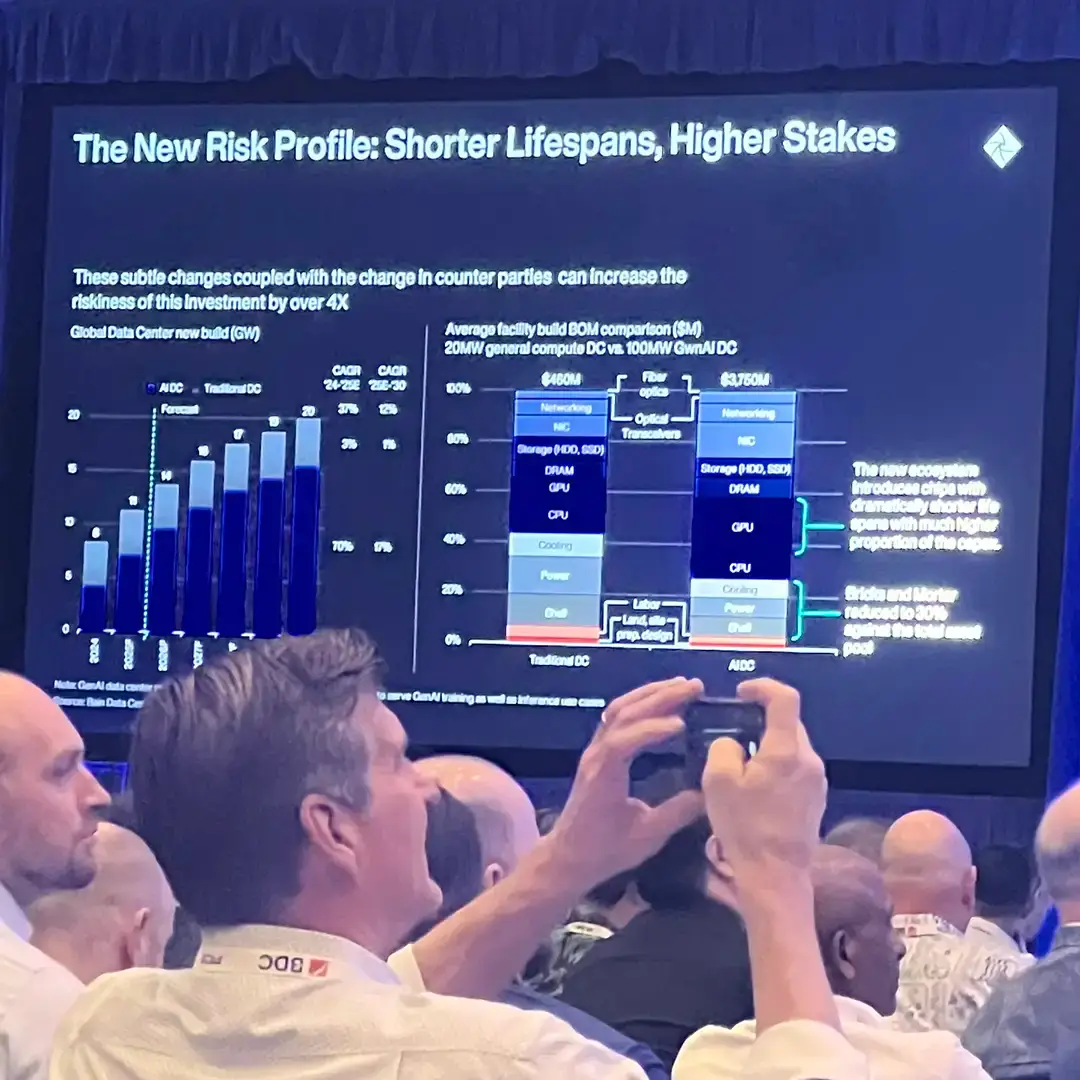
AI has inverted the capital stack. Barney warned that GPUs, now a dominant share of CapEx, often have “one- to three-year” lifespans, undermining traditional debt models built around 30-year assets. Bhandari reinforced the investor risk: one failed giga-scale AI project could reset sentiment across the entire market.
7) Process. As a key constraint.
Dave Coughlan, CEO of SubCom, challenged the assumption that manufacturing is the bottleneck. “I don’t see a supply constraint,” he said, pointing instead to demand visibility and permitting delays. SubCom, he noted, has scaled production from “37,000 kilometers…to 60,000 kilometers this year,” with a path to “100,000 within 24 months.”
8) Reliability. As an architectural principle.
Brian Quigley, Vice President of Network Infrastructure at Google, described a strategic shift toward segmented subsea systems designed so failures do not “bring down the full system.” Redundancy, he explained, is no longer insurance; it is core architecture in an AI-driven world.
9) Sovereignty. As an infrastructure requirement.
Bevan Slattery, Founder and CEO of SUBCO, warned that when cloud control planes fail, “everything stops.” Sovereignty, once an abstract policy debate, has become an engineering problem. Quigley outlined emerging “trusted partner” cloud and subsea models, while Randy Brouckman, CEO of EdgeConneX, grounded the concept operationally: “Power and data centers are no longer separate industries.”
10) Operating inside a K-shaped economy
Barney framed the macro context as a “K-shaped economy,” where technology firms accelerate while much of the traditional economy stagnates. That divergence, he warned, is not just economic but political, placing infrastructure operators at the center of broader societal tensions.
PTC’26 made clear that the industry is no longer selling bandwidth, square footage, or megawatts. It is selling resilience—economic, political, and human. Or, as Quigley put it, “stability and a clear process, even if it takes a long time, is much more acceptable than ‘we’re just not sure’.”
The future is shooting fast. Brian Moon and the PTC team seized the moment and caught a star. The question is whether the people, power, and policies required to sustain it can arrive in time. PTC’27 isn’t coming fast enough to find out…
Over the past 30 years, 26FIVE has attended, participated in, and managed the PTC Conference on behalf of 100+ clients. The views expressed herein are solely those of 26FIVE. All quotes and attributions are taken directly from conference sessions and related discussions during PTC’26 on January 17-20, 2026.